
The risks, explained without the marketing
This page is a compliance-side inventory of what an offshore operator does not do, and what a UKGC licensee has to do because the Licence Conditions and Codes of Practice make it non-negotiable. The gap between the two regimes is the compliance cost. The reason offshore welcome offers can be larger, the reason the customer journey feels smoother at the top end, and the reason the friction reappears when something goes wrong, all sit in that gap.
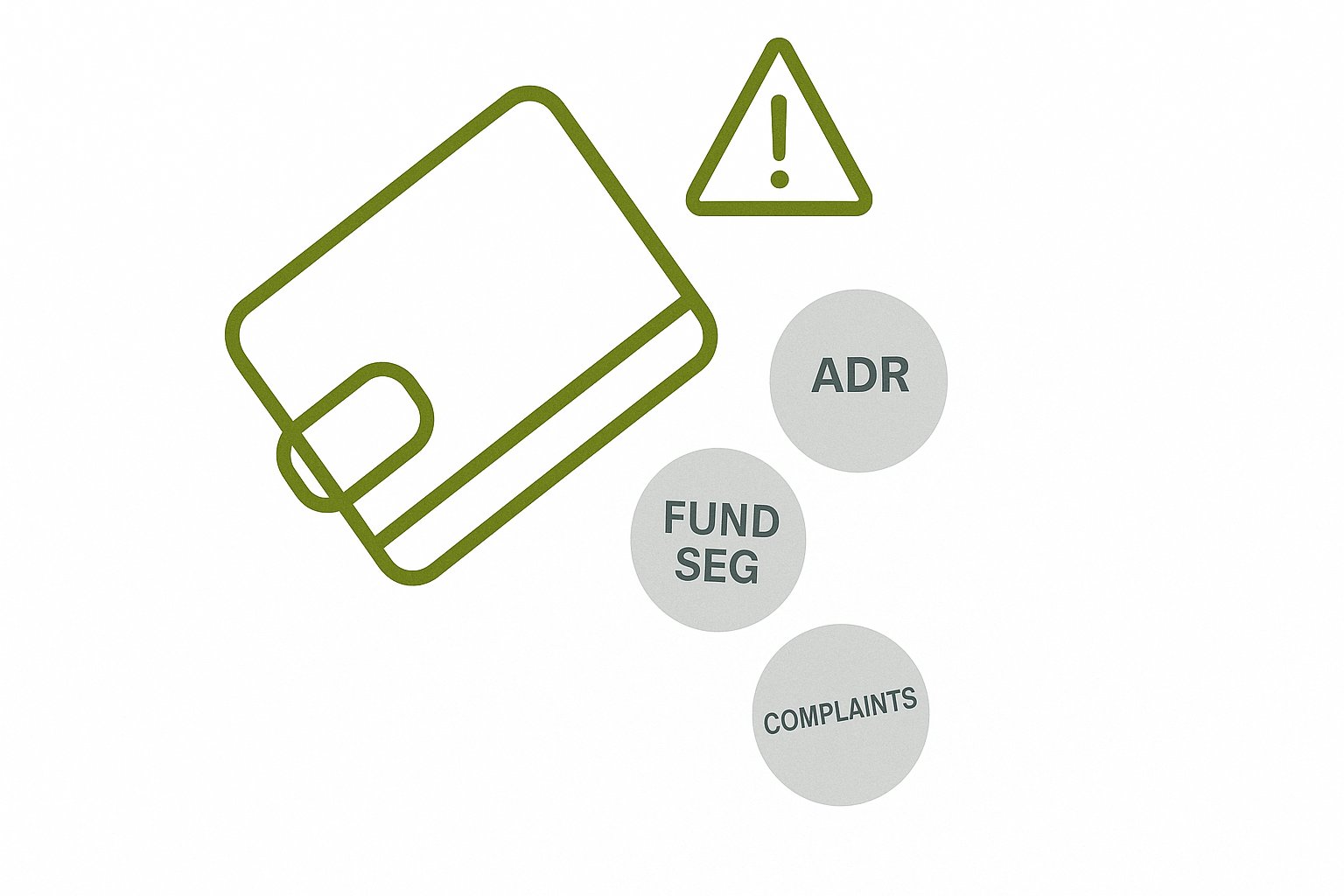
No UKGC oversight, what that means day to day
The UK Gambling Commission's oversight of a licensed operator is not a light-touch audit that visits once a year. It is a constant supervisory presence built on regulatory returns, key events reporting under Licence Condition 15.2, annual assurance statements, periodic thematic reviews, targeted operator inspections, and the public enforcement register that publishes every regulatory settlement and public statement with the operator named. Inside the operator, the shape of that supervision is felt in every internal review meeting, every reworded piece of customer communication, every source of funds decision the money laundering reporting officer signs off, and every safer gambling training pack refreshed on the schedule the Commission expects to see. A UKGC-licensed operator that stops paying attention to any one of those lines drifts into breach territory within a quarter.
None of that supervisory scaffolding sits behind an offshore operator serving a UK adult. What sits behind an offshore operator, at best, is its own home regulator's licensing regime, which in most cases operates on a light-touch model with a much lower expectation of ongoing reporting, no personal management licence layer, no public enforcement register comparable to the Commission's, and no direct route into the UK's harm-reduction architecture. The day-to-day effect for a UK customer is that a mistake the offshore operator makes about their account is unlikely to be caught by an external audit, unlikely to be reported to any regulator anyone can read, and unlikely to lead to any change in how the operator treats the next customer that hits the same edge case. Nothing about that is unlawful under UK law. It is simply what a UK adult is choosing when they cross the border of the licensed sector. The absence of ongoing supervision is not a criticism the offshore regulator would recognise, because the offshore regulator was not set up to be a UK-facing consumer body and does not hold itself to any UK-facing standard.
02No fund segregation guarantee
Licence Condition 4 of the LCCP requires UKGC-licensed operators to hold customer funds separately from operating funds and to disclose the level of protection to customers at sign-up. The Commission has published three tiers of protection, basic, medium and high, and each tier attaches a defined arrangement of trust, insurance or bank facility to the customer's balance. A high-protection operator, for example, has a trust arrangement audited by a third party with independent access to the assets. A basic-protection operator holds funds in an account separate from operating funds without an equivalent legal insulation. The point of the tiered regime is not that basic is bad. It is that every UK customer at a licensed operator can see, at sign-up, the level of protection applied and can make a decision with that information in front of them.
An offshore operator has no equivalent regime. Some offshore operators say they hold funds separately, and some may in fact do so, but there is no UK-supervised arrangement behind the claim, no published tier standard against which the arrangement can be assessed, and no external audit a UK customer can rely on to verify the state of the underlying account. In practical terms, what the customer's balance represents at an offshore operator is a book entry on the operator's own systems. If the operator's parent group experiences a solvency event, if a payment provider withdraws support, if the operator's own home regulator suspends the licence, the customer's book entry may or may not correspond to a claim on any asset the customer can reach. That structural risk is one of the specific losses a UK adult accepts when they play outside the UKGC-licensed sector.
A closer look
Inside a UKGC-licensed operator, the fund segregation arrangement is a topic the finance team, the compliance team and the auditors revisit each year. It is disclosed on the operator's own site under Licence Condition 4.2, it is reviewed by the Commission on request, and it is a data point new customers can look up before opening an account. Nothing on the offshore side is comparable, and no amount of marketing gloss on an offshore operator's own site changes the underlying legal shape of the arrangement.
03No mandatory ADR body
Licence Condition 6 of the LCCP requires UKGC-licensed operators to belong to an approved alternative dispute resolution provider, to disclose the ADR route to customers, and to accept the ADR body's decisions on customer disputes. The ADR body publishes its standards, publishes an annual statistical report, and gives the customer a written adjudication that the operator is bound to comply with. That is not a perfect mechanism, and no compliance manager who has watched it operate would describe it in those terms. It is a public floor of accountability that a licensed operator's board is compelled to respect, and its existence changes the shape of every difficult customer decision a compliance team makes.
Nothing equivalent applies to an offshore operator serving a UK adult. The offshore operator may offer an internal dispute service, may signpost the customer to its own home regulator's complaints process, or may point at a private mediation body that has no standing in the UK. None of those options gives the customer an adjudication a UK court will readily enforce, none of them commits the operator to a public statistical disclosure, and none of them creates the reputational pressure that the ADR body's published outcomes generate for the licensed sector. That is the shape of the second layer that is missing on the offshore side, and it is one of the reasons the compliance cost between the two regimes is so different. The absence of ADR is also what makes the balance-of-power in a disputed transaction so lopsided at the offshore end, because the operator knows the customer's practical path is either to accept the operator's own decision or to walk away with nothing.
04Offshore licensing landscape after Curacao LOK 2024
The Landsverordening op de Kansspelen, or LOK, came into force in Curaçao on 24 December 2024 and reshaped the offshore licensing regime that had supplied a large share of the UK-facing non-UKGC market for the previous two decades. Before the LOK, Curaçao ran a master-licence system under which four master holders sub-licensed hundreds of operator sites with no direct regulator visibility on the sub-licensees. The LOK abolished the master-licence structure and replaced it with a single-regulator model, under which every operator holds a direct licence from the Curaçao Gaming Authority, must appoint a registered agent inside the territory, and is expected to comply with AML and technical standards that read closer to the UK regime than the pre-2024 baseline did.
What the LOK does not do, and this is the point the offshore marketing pages do not put on the same screen as their welcome offer, is create anything a UK adult can rely on as an equivalent to the UKGC framework. The LOK does not extend the UK Consumer Rights Act 2015 to a Curaçao-domiciled operator, does not create a UK-recognised ADR body attached to a Curaçao licence, does not mandate GamStop integration, does not reach into the personal management licence regime that names individuals inside a UK operator, and does not oblige the operator to publish a fund-segregation tier a UK customer can look up. The LOK narrows the AML and technical gap. It does not close the consumer-protection gap.
Key points
- The UKGC compliance stack rests on LCCP, personal management licences, statutory audits and public enforcement
- The Curaçao LOK 2024 narrowed the AML gap but did not extend UK consumer protection offshore
- Five specific layers that go missing offshore: ADR, fund segregation, customer interaction, PML accountability, GamStop
- The compliance-cost gap explains why offshore welcome offers can look significantly more generous
Anjouan, MGA, Gibraltar, how they compare
Anjouan has become an increasingly visible jurisdiction for UK-facing offshore operators as the pre-LOK Curaçao market has restructured. Anjouan licences are cheaper to obtain, faster to process, and operate under a lighter regulatory framework than the LOK regime that replaced the old Curaçao model. From a UK compliance perspective, the practical differences a customer meets at an Anjouan-licensed operator are broadly similar to the pre-LOK Curaçao pattern, with the same absence of UK-recognised ADR, the same absence of fund-segregation supervision at UK standard, and the same absence of any hook into the UK harm-reduction architecture. The Malta Gaming Authority and the Gibraltar Gambling Commissioner sit in a different bracket, with more mature regulatory frameworks, closer alignment to European standards, and in the case of Gibraltar historic close ties to the UK regime prior to Brexit, but neither creates a UK enforcement route for a UK customer whose deposit has gone offshore.
The point of the comparison is not that one offshore regulator is materially better than another for a UK customer. From the customer's own enforcement perspective, all of them are outside the UKGC's remit and all of them leave the customer with the same practical answer to a dispute, which is a civil claim in a foreign court where the cost of pursuit will almost always exceed the value of the disputed amount. Inside the operator, the differences between the offshore regimes are visible in the technical standards, AML expectations and reporting cadences the operator has to meet with its own home regulator. Outside the operator, at the customer's end, the practical outcome converges. What the customer accepts is a licence issued by a regulator that has no jurisdiction in the UK.
A closer look
A UK adult reading an offshore operator's licence disclosure at the footer of the site is looking at a piece of information that tells them who supervises the operator's home compliance, not who supervises the operator's UK-customer treatment. The distinction matters, and it is one of the things marketing pages avoid making explicit. The licence disclosure is a legal-domicile fact, not a consumer-protection guarantee.
06Payment friction that is only growing
Since the White Paper 2023 implementation cycle began, UK payment infrastructure has moved in a single direction on gambling transactions, and it is toward friction rather than away from it. HSBC, Monzo, Starling, Lloyds and Barclays offer voluntary gambling-block card switches, most enforced at the card scheme or the mobile banking app, most with a mandatory cool-down of between 48 hours and seven days before the block can be lifted after a request to turn it off. The Visa and Mastercard 2025 merchant-category taskforce tightened enforcement of MCC 7995 so a payment marked as a gambling transaction by the acquirer cannot be rerouted through a non-gambling category by the receiving operator without risking scheme sanction. Cryptocurrency rails hit the same know-your-customer wall at the exchange, because UK-domiciled exchanges are supervised by the FCA and the fifth anti-money-laundering directive and cannot process a gambling-flagged outbound flow without applying their own AML checks.
The direction of travel is intentional. UK banks did not build these controls to be inconvenient. They built them because their own customers, and their customers' families, asked for a way to hold a decision the customer had already made whilst calm. The payment-side friction offshore operators meet is not a licensed-sector conspiracy against them. It is the outward expression of a public-health policy that has bipartisan political support in the UK, is funded by the statutory levy that came into force on 6 April 2025, and is likely to increase over the next three to five years rather than decrease. A UK adult depositing at an offshore operator today is meeting more friction than the same customer would have met in 2020, and the friction curve continues to bend the same way.
What happens to your ID documents
A UKGC-licensed operator is a data controller under the UK GDPR and the Data Protection Act 2018. It is required to keep personal data secure, to hold it only for as long as is necessary for the specified purpose, and to give the data subject the rights set out in Articles 12 to 22 of the UK GDPR. Those rights include a right of access, a right to rectification, a right to erasure in defined circumstances, and a right to complain to the Information Commissioner's Office as an independent supervisory authority. The operator's data protection officer is a role required under Article 37 where the processing meets the qualifying tests, and in the operator I worked in that role sat inside the compliance function alongside the money laundering reporting officer.
An offshore operator serving a UK adult is not necessarily subject to the UK GDPR at the same enforcement standard, and the ICO's practical ability to pursue a data-protection complaint against a foreign-domiciled controller is limited. The offshore operator's own home data-protection law may or may not offer equivalent rights, and the enforcement route the customer would use to assert those rights runs through a foreign regulator with no UK-facing complaints intake. What a UK customer is giving up when they upload identity documents to an offshore operator is not just the money in the deposit. It is the practical enforceability of the data-protection regime that would ordinarily sit behind the operator's handling of the customer's name, address, date of birth, and the passport or driving licence scan the operator asked for at sign-up.
08Practical harm-reduction if a deposit has already gone
If a deposit has already gone to an offshore operator and the customer is reading this page in the aftermath, nothing on the enforcement side is likely to be a quick answer. What is available is the harm-reduction side, and the harm-reduction side runs on public numbers and public routes rather than on private enforcement. The National Gambling Helpline on 0808 8020 133 is open, free and confidential 24 hours a day, and the adviser who picks up does not ask which operator the customer used or where the deposit went. GamCare's live chat via gamcare.org.uk runs on the same standards. GamStop enrolment through gamstop.co.uk applies to every UKGC-licensed remote site the moment enrolment is complete, and it protects the customer from repeating the same route at any licensed operator whilst the exclusion is active.
The bank side of the harm-reduction toolkit is also available and often overlooked. A gambling-block card switch enabled through HSBC, Monzo, Starling, Lloyds or Barclays applies to any card transaction the bank's rules engine flags as a gambling transaction, and the block does not depend on the operator being UKGC-licensed. That is one of the few controls that reaches an offshore transaction from the customer's own bank rather than from the Commission. Setting the switch on takes minutes in the mobile app. Turning it off, once on, is where the cool-down applies, and that cool-down is the point at which the customer's earlier calm decision does its work. None of this replaces the enforcement route the customer does not have. It gives the customer a set of practical protections the offshore side does not run.
Read next
- GamStop explained, the scheme, the periods, the checks
- The legal position for UK players outside GamStop
- Payments and checks, banks, cards, crypto, KYC
- Coming off GamStop, the official route
- Getting support, helplines, clinics, family, money
Sources and verification
The description of the LCCP framework, Licence Condition 4 customer funds protection, Licence Condition 6 ADR, Licence Condition 15.2 key events, SRCP 3.4.1 customer interaction, SRCP 3.5.5 GamStop integration and the personal management licence regime is verified against the current published Licence Conditions and Codes of Practice on gamblingcommission.gov.uk. The Curaçao LOK 2024 dates and the 2024/25 UK enforcement figures are cross-checked against the same source. Last checked 5 August 2026.
Frequently asked questions
What is the biggest single thing an offshore operator skips
The personal management licence regime. A UKGC licensee has to name individuals to hold specified management functions, and those individuals are personally accountable to the Commission for their function's compliance. That accountability changes every internal decision the operator makes. An offshore operator has no equivalent regime, no named-individual accountability to a UK regulator, and therefore no personal exposure at the point where a decision affects a customer's protection.
Does the Curaçao LOK 2024 close the gap with UK standards
It narrows some parts of the gap but does not close it. The Landsverordening op de Kansspelen came into force on 24 December 2024 and moved Curaçao from a master-licence system to a single-regulator regime under the Curaçao Gaming Authority. It introduces AML and technical standards that read closer to the UK regime than the pre-2024 baseline. It does not create UK-recognised ADR, does not extend the UK Consumer Rights Act 2015 to the transaction, does not mandate fund segregation to UK licensed-sector standard, and does not reach into the personal management licence regime that names individuals inside a UK operator.
What are the specific consumer-protection layers that disappear
The five most concrete losses are mandatory ADR under LCCP Licence Condition 6, mandatory customer-funds protection under LCCP Licence Condition 4, mandatory customer-interaction under LCCP SRCP 3.4.1, the personal management licence accountability layer, and mandatory GamStop integration under LCCP SRCP 3.5.5. Each of those is enforceable against a UKGC licensee. None of them is enforceable against an offshore operator by any UK route.
Is fund segregation the same as customer-funds protection
Not exactly. Licence Condition 4 requires UKGC-licensed operators to hold customer funds separately from operating funds and to disclose the level of protection applied. The three published tiers are basic, medium and high, and the level of trust or insurance arrangement is required to be shown on the operator's site. Offshore operators may say they hold funds separately, but there is no UK-supervised arrangement, no published tier standard applied by a regulator with UK reach, and no external audit a UK customer can rely on to verify the claim.
How much does the compliance layer actually cost a UKGC operator
It varies by operator size but is material. A mid-sized UKGC-licensed remote operator will run headcount for a money laundering reporting officer, a compliance manager, a safer gambling team of several people, and a data protection officer, alongside external audit costs, ADR provider fees, statutory levy contributions at 1.1 per cent of gross gambling yield for online, and technology spend on register integrations and monitoring. The overall compliance-cost gap between a UKGC operator and an offshore operator on the same customer book is one of the reasons offshore welcome offers can be twice as generous.
Talk to someone today
The National Gambling Helpline is free, confidential and open 24 hours a day, seven days a week.